
I treni arancioni, sebbene non facciano parte del sistema della metropolitana di Roma, sono stati oggetto delle attenzioni della scena writing romana.
Si tratta di treni che giravano parecchio nelle immediate vicinanze della città, erano linee metropolitane, un pò come la rete RER di Parigi. C'era la "FM1" che collegava l'aeroporto di Fiumicino a Fara Sabina, attraversando tutta la città: da Roma Nomentano, alla Tuscolana, Ostiense, Trastevere, Magliana...
Alcuni arancioni andavano a finire anche a Civitavecchia e altrove ancora.
Il primo end to end che ho visto sugli arancioni era degli NSB più alcuni ospiti francesi. Un end to end argentone spettacolare Washe, Manjar, Hoctes, Legz.
All'epoca, nel '95, non c'erano mai pezzi sugli arancioni perchè non c'era un deposito vero e proprio dove dipingerli. L'end to end degli NSB era un pò un'eccezione che dimostrava come qualsiasi supporto su rotaia poteva essere dipinto se si beccava lo spot e il momento giusto.
Grazie alle ricerche del Mencio, riuscimmo a scovare un layup perfetto, alla stazione di Velletri.

Durante l'inverno, appena le giornate erano buie si potevano dipingere fino a due treni diversi, bastava aspettare che partisse il primo e che arrivasse il secondo, nel tardo pomeriggio, senza neanche fare le ore piccole. Il treno veniva lasciato lì una mezz'oretta.
Ci recavamo a Velletri col treno che avremmo dipinto. Eravamo i pendolari del writing. Durante il tragitto, oltre a taggare gli interni dappertutto, ognuno di noi sceglieva quale parte di vagone dipingere, la spartizione del vagone dava spazio a lunghi negoziati.
Mi ricordo che bisognava fare il giro della stazione e scalare un ripido montarozzo pieno di rovi, sassi, terra e frasche in cima al quale si trovava il treno. C'era sempre un'umiditá bestiale e il cane di un pecoraro che abbaiava in sottofondo.
Finiti i pezzi ci andavamo a mangiare una pizza al taglio o un supplì per rifocillarci, e poi riprendere il nostro treno per tornarcene a Roma. Una volta perdemmo l'ultimo treno delle 21 e con Snoy e Sila dovemmo prendere la corriera da Velletri ad Anagnina. Un'altra volta, per via di uno sciopero dei macchinisti, il treno venne portato via mentre lo stavamo dipingendo e fummo costretti a sospendere le operazioni. Ogni uscita era una storia a sè. Fu così che tra il '96 e il '97, gli arancioni iniziarono ad essere bombati.
Altri writers e crew ci chiesero di portarli a dipingere gli arancioni, ma nella nostra crew ci eravamo messi d'accordo per non divulgare dove venivano dipinti i treni. Era un consiglio che ci aveva dato il Trota. Lo scopo era di mantenere un monopolio sui treni arancioni, che sarebbero stati solo nostri: che stronzi che eravamo!
Ci fù un periodo che una marca di caffè, la Kimbo, appiccicò su tutti i vagoni una pubblicità adesiva che copriva i nostri pezzi. Col tempo variavamo i posti dove dipingere per non bruciare Velletri. Furono spot meno felici e usati con minor regolarità: Ladispoli, Orte...
Una volta con Gast andammo a Fara Sabina di giorno per provare a farci un arancione lì, ma dovemmo allontanarci a metà dell'opera davanti ad un "Aò! A regazzì! Che-staffà!". Un'altra volta a Ciampino sempre con Gast, arrivò in banchina una vecchietta che ci sgridò. Noi non ci siamo fermati rispondendo alla vecchietta che se non era contenta poteva chiamare le guardie.
A differenza della metro, gli arancioni non hanno mai dato luogo nè a sparatorie, nè a ferimenti: sapevamo che le FS non potevano mettere una guardia in banchina a tutte le stazioni.
Poi quando si iniziò a dipingere a Ciampino, gli arancioni divennero accessibili anche agli altri writer.
Asme PAC
English:
Clockwork Orange
The orange trains, even though they are not part of the Roman subway system, were object of attention by the Roman writing scene.
They are trains that ran a lot in the immediate vicinity of the city, the were sort of like metropolitan lines, pretty much like the RER lines of Paris. There was the "FM1" that connected the Fiumicino airport to Fara Sabina, crossing the whole city: from Roma Nomentano, to Tuscolana, Ostiense, Trastevere, Magliana...
Some orange trains ended up in Civitavecchia and other places.
The first end to end I saw running on the orange trains was by the NSB crew and some French guests. A spectacular silver end to end by Washe, Manjar, Hoctes, Legz.
At the time, in 1995, there were no pieces on the orange trains because there was no real depot where to paint them. The NSB end to end was an exception that demonstrated how any medium on tracks could be painted if you found the right spot and the right time.
Thanks to Mencio's explorations, we were able to find a perfect layup at the Velletri station.
During the winter, as soon as the days turned darker, it was possible to paint up to two different trains. All you had to do was wait for the first train to leave and for the second to arrive. All during the late afternoon, there was no need to wait till late at night. The train stood there a good half-hour.
We went to Velletri on the train we would have painted. We were the graffiti-commuters. On the way, apart from tagging the insides everywhere, each of us chose which part of the car to paint. The division of the space on the carriage gave way to long negotiations.
I remember we had to walk around the station and climb a steep slope full of bushes, rocks, and dirt, on top of which was our train. It was always damn humid, and a sheep dog that constantly barked in the background.
Once finished painting we went to get some pizza or supplì to refresh ourselves and then take our train back to Rome. One time we lost the last train at 21 hours and together with Snoy and Sila we had to take the coach from Velletri to Anagnina. Another time, because of a train-driver strike, the train drove off while we were painting and had to suspend all operations. Every outing was a story unto itself. That is how, between '96 and '97, the orange trains started getting bombed.
Other writers started asking us to bring them with us to paint the orange trains, but among our crew we had all agreed to not divulge where we painted those trains. It was a suggestion Trota had given us. The purpose was to maintain a monopoly on the orange trains that would have remained only ours: what ass-holes we were!
Si tratta di treni che giravano parecchio nelle immediate vicinanze della città, erano linee metropolitane, un pò come la rete RER di Parigi. C'era la "FM1" che collegava l'aeroporto di Fiumicino a Fara Sabina, attraversando tutta la città: da Roma Nomentano, alla Tuscolana, Ostiense, Trastevere, Magliana...
Alcuni arancioni andavano a finire anche a Civitavecchia e altrove ancora.
 |
| Mappa delle linee urbane ed extra-urbane. |
Il primo end to end che ho visto sugli arancioni era degli NSB più alcuni ospiti francesi. Un end to end argentone spettacolare Washe, Manjar, Hoctes, Legz.
 |
| End to end dei romani Washe e Manjar NSB, e Hoctes e Legs da Parigi. Stazione Ostiense, 1995. |
All'epoca, nel '95, non c'erano mai pezzi sugli arancioni perchè non c'era un deposito vero e proprio dove dipingerli. L'end to end degli NSB era un pò un'eccezione che dimostrava come qualsiasi supporto su rotaia poteva essere dipinto se si beccava lo spot e il momento giusto.
Grazie alle ricerche del Mencio, riuscimmo a scovare un layup perfetto, alla stazione di Velletri.

Durante l'inverno, appena le giornate erano buie si potevano dipingere fino a due treni diversi, bastava aspettare che partisse il primo e che arrivasse il secondo, nel tardo pomeriggio, senza neanche fare le ore piccole. Il treno veniva lasciato lì una mezz'oretta.
Ci recavamo a Velletri col treno che avremmo dipinto. Eravamo i pendolari del writing. Durante il tragitto, oltre a taggare gli interni dappertutto, ognuno di noi sceglieva quale parte di vagone dipingere, la spartizione del vagone dava spazio a lunghi negoziati.
Mi ricordo che bisognava fare il giro della stazione e scalare un ripido montarozzo pieno di rovi, sassi, terra e frasche in cima al quale si trovava il treno. C'era sempre un'umiditá bestiale e il cane di un pecoraro che abbaiava in sottofondo.
 |
| Clone PAC, 1996. |
 |
| Rase PAC, 1996. |
Finiti i pezzi ci andavamo a mangiare una pizza al taglio o un supplì per rifocillarci, e poi riprendere il nostro treno per tornarcene a Roma. Una volta perdemmo l'ultimo treno delle 21 e con Snoy e Sila dovemmo prendere la corriera da Velletri ad Anagnina. Un'altra volta, per via di uno sciopero dei macchinisti, il treno venne portato via mentre lo stavamo dipingendo e fummo costretti a sospendere le operazioni. Ogni uscita era una storia a sè. Fu così che tra il '96 e il '97, gli arancioni iniziarono ad essere bombati.
 |
| Asme e Syla PAC, 1998. |
 |
| Mencio PAC, 1998. |
Altri writers e crew ci chiesero di portarli a dipingere gli arancioni, ma nella nostra crew ci eravamo messi d'accordo per non divulgare dove venivano dipinti i treni. Era un consiglio che ci aveva dato il Trota. Lo scopo era di mantenere un monopolio sui treni arancioni, che sarebbero stati solo nostri: che stronzi che eravamo!
 |
| "PAC Orange Masters", 1997. |
Ci fù un periodo che una marca di caffè, la Kimbo, appiccicò su tutti i vagoni una pubblicità adesiva che copriva i nostri pezzi. Col tempo variavamo i posti dove dipingere per non bruciare Velletri. Furono spot meno felici e usati con minor regolarità: Ladispoli, Orte...
 |
| Throwup GA GA GA di Gast ZTK sul vagone a sinistra. Sul vagone pellicolato, Mencio striscia il nome di una nota marca di caffè con una sottile linea, la stessa che segna il confine fra il concetto di legale/illegale, 1998. |
 |
| Pubblicità Kimbo con tag e throwup di Gast ZTK. Le lettere adesive che componevano la scritta Kimbo sono state staccate e riattaccate per comporre il nome della crew "THE". Stazione Termini, 1999. |
Una volta con Gast andammo a Fara Sabina di giorno per provare a farci un arancione lì, ma dovemmo allontanarci a metà dell'opera davanti ad un "Aò! A regazzì! Che-staffà!". Un'altra volta a Ciampino sempre con Gast, arrivò in banchina una vecchietta che ci sgridò. Noi non ci siamo fermati rispondendo alla vecchietta che se non era contenta poteva chiamare le guardie.
A differenza della metro, gli arancioni non hanno mai dato luogo nè a sparatorie, nè a ferimenti: sapevamo che le FS non potevano mettere una guardia in banchina a tutte le stazioni.
Poi quando si iniziò a dipingere a Ciampino, gli arancioni divennero accessibili anche agli altri writer.
Asme PAC
 |
| Dome CB, 1999. |
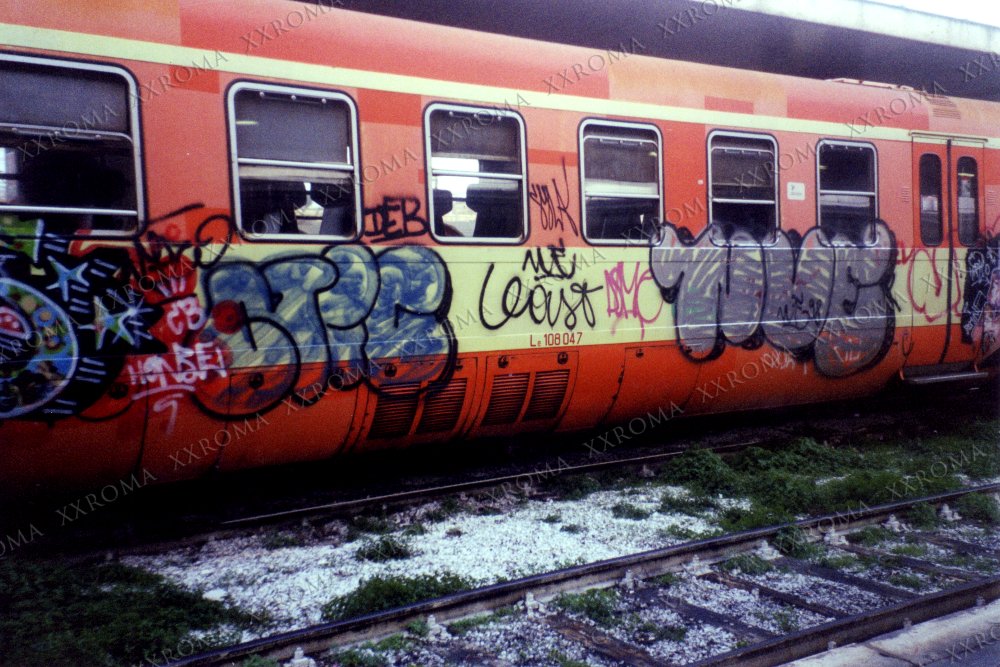 |
| Throwup Nic TRV, Nue, e tag Gast ZTK, Asme PAC, Syla PAC, Deb MT2. 1998. |
 |
| Dest TUW AFP (R.I.P.), 1998. |
 |
| Faina CB, Rye, Iems QRP RZ, Yes TUW, Jame PJ, 1999. |
English:
Clockwork Orange
The orange trains, even though they are not part of the Roman subway system, were object of attention by the Roman writing scene.
They are trains that ran a lot in the immediate vicinity of the city, the were sort of like metropolitan lines, pretty much like the RER lines of Paris. There was the "FM1" that connected the Fiumicino airport to Fara Sabina, crossing the whole city: from Roma Nomentano, to Tuscolana, Ostiense, Trastevere, Magliana...
Some orange trains ended up in Civitavecchia and other places.
|
| Map of the Roman train lines. |
The first end to end I saw running on the orange trains was by the NSB crew and some French guests. A spectacular silver end to end by Washe, Manjar, Hoctes, Legz.
|
| End to end by the Romans Washe and Manjar NSB, and Hoctes and Legs from Paris. Ostiense station, 1995. |
At the time, in 1995, there were no pieces on the orange trains because there was no real depot where to paint them. The NSB end to end was an exception that demonstrated how any medium on tracks could be painted if you found the right spot and the right time.
Thanks to Mencio's explorations, we were able to find a perfect layup at the Velletri station.
During the winter, as soon as the days turned darker, it was possible to paint up to two different trains. All you had to do was wait for the first train to leave and for the second to arrive. All during the late afternoon, there was no need to wait till late at night. The train stood there a good half-hour.
We went to Velletri on the train we would have painted. We were the graffiti-commuters. On the way, apart from tagging the insides everywhere, each of us chose which part of the car to paint. The division of the space on the carriage gave way to long negotiations.
I remember we had to walk around the station and climb a steep slope full of bushes, rocks, and dirt, on top of which was our train. It was always damn humid, and a sheep dog that constantly barked in the background.
|
| Clone PAC, 1996. |
|
| Rase PAC, 1996. |
Once finished painting we went to get some pizza or supplì to refresh ourselves and then take our train back to Rome. One time we lost the last train at 21 hours and together with Snoy and Sila we had to take the coach from Velletri to Anagnina. Another time, because of a train-driver strike, the train drove off while we were painting and had to suspend all operations. Every outing was a story unto itself. That is how, between '96 and '97, the orange trains started getting bombed.
|
| Asme and Syla PAC, 1998. |
|
| Mencio PAC, 1998. |
Other writers started asking us to bring them with us to paint the orange trains, but among our crew we had all agreed to not divulge where we painted those trains. It was a suggestion Trota had given us. The purpose was to maintain a monopoly on the orange trains that would have remained only ours: what ass-holes we were!
|
| "PAC Orange Masters", 1997. |
There was a period that a famous coffee-brand, Kimbo, pasted an adhesive advert on all the carriages, over our pieces. As time passed we changed spots where we painted so as not to fuck up Velletri. They were spots that were not as good and used less regularly, like Ladispoli and Orte.
|
| GA GA GA throwups on the orange car by Gast ZTK. On the white car, Mencio crosses out the name of a famous coffee brand with a line, the same fine line that marks the boundary between the concepts of legal and illegal, 1998. |
|
| Gast ZTK bombs a Kimbo coffee advert. The red and black adhesive letters forming the name Kimbo are rearranged to spell out "THE" crew. Termini station, 1999. |
One time Gast and I went to Fara Sabina by day to try and paint a train there, but were forced to leave half-way through our pieces with an, "hey Kids! Whatta hell ya doin'!" Another time in Ciampino with Gast as well, an old lady came up on the platform and started scolding us. We just kept painting, telling the old lady that if she was not happy she could call the cops.
Unlike the subway, the orange trains never gave rise to shootings. We knew the FS company could not afford to put guards on the platforms of every station.
When Ciampino station came into the picture, the orange trains started getting painted by other writers as well.
Asme PAC.
|
| Dome CB, 1999. |
|
| Throwups by Nic TRV and Nue. Tags by Gast ZTK, Asme and Syla PAC, and Deb MT2. 1998. |
|
| Dest TUW (R.I.P.). 1998. |
|
| Faina CB, Rye, Iems QRP RZ, Yes TUW, Jame PJ, 1999. |


